Never Have I Ever Family Reunion Edition: 60 Questions
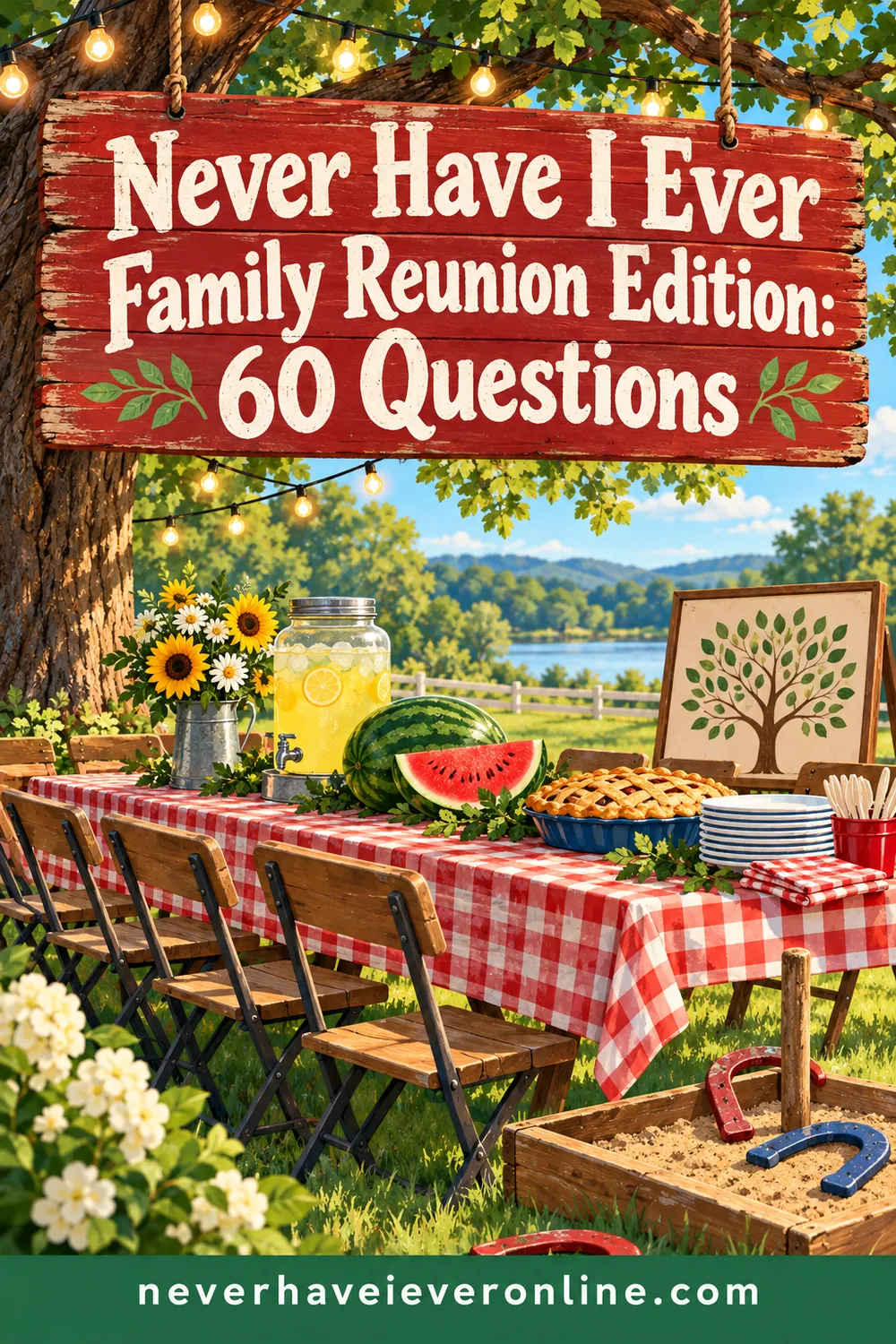
A never have I ever family reunion game works because everyone in the crowd shares the same family stories but remembers them differently: read a statement, and every cousin, aunt and grandparent it is true for raises a hand, then the fun starts as people fill in the details. The 60 clean statements below are written for big, multi-generation groups at a park pavilion, backyard or campground.
A reunion is a strange mix. You have relatives who see each other every Sunday and second cousins who have not met since a wedding twelve years ago. Small talk only goes so far. A quick round of never have I ever gives everyone something to laugh about, and it surfaces stories the younger generation has never heard.
60 Never Have I Ever Family Reunion Statements
Each section targets a different part of family life. Statements are written so that grandparents, parents, teens and grown cousins can all play, and nothing asks anyone to admit something embarrassing in front of the whole clan.
Cousins and Childhood Memories
- Never have I ever been mistaken for one of my cousins.
- Never have I ever been dressed in matching outfits with my cousins for a photo.
- Never have I ever built a fort with cousins at a family gathering.
- Never have I ever stayed up past midnight talking with a cousin at a sleepover.
- Never have I ever been blamed for something a cousin actually did.
- Never have I ever been given a family nickname I could not shake.
- Never have I ever learned to swim, ride a bike or fish from an aunt or uncle.
- Never have I ever had a secret clubhouse or hideout at a grandparent's house.
- Never have I ever sat at the kids' table well past the age I should have moved up.
- Never have I ever traded secrets with a cousin that I still have not told anyone.
Family Traditions
- Never have I ever been in charge of bringing the same dish to every gathering.
- Never have I ever played the same lawn game at every reunion I can remember.
- Never have I ever taken part in a family talent show.
- Never have I ever been asked to say grace or give a toast at a big family meal.
- Never have I ever worn a matching family reunion T-shirt.
- Never have I ever learned a family recipe straight from the person who created it.
- Never have I ever sung a family song that nobody outside the family knows.
- Never have I ever posed for a giant group photo that took more than ten tries.
- Never have I ever helped plan a family reunion.
- Never have I ever kept a family tradition going after I moved out.
Road Trips and Getting There
- Never have I ever driven more than six hours to get to a family reunion.
- Never have I ever gotten lost on the way to a relative's house.
- Never have I ever shared a hotel room with more than four relatives.
- Never have I ever slept on a relative's couch or floor during a visit.
- Never have I ever flown across the country for a family event.
- Never have I ever arrived at a reunion a full day early or a full day late.
- Never have I ever carpooled with a relative I barely knew and become friends.
- Never have I ever forgotten something important at home on the way to a reunion.
- Never have I ever packed a cooler so full the lid would not close.
- Never have I ever played a car game that lasted the whole drive.
Food, Cookouts and Picnic Tables
- Never have I ever eaten three desserts at one family gathering.
- Never have I ever been trusted to run the grill.
- Never have I ever claimed the last slice of a famous family pie.
- Never have I ever made a dish for a reunion and had it come home untouched.
- Never have I ever packed a plate of leftovers to take home.
- Never have I ever gotten into a friendly debate about whose potato salad is best.
- Never have I ever sneaked a taste of a dish before it was served.
- Never have I ever eaten watermelon and had a seed-spitting contest.
- Never have I ever been the one who forgot to bring the ice.
- Never have I ever asked a relative for a recipe and gotten "a little of this, a little of that."
Family History and Roots
- Never have I ever looked through a family photo album older than my parents.
- Never have I ever visited the town where my grandparents grew up.
- Never have I ever helped build or update a family tree.
- Never have I ever discovered a relative I never knew I had.
- Never have I ever heard a family story that turned out to be only half true.
- Never have I ever been told I look just like a relative from an old photo.
- Never have I ever inherited something special from a grandparent.
- Never have I ever met a great-aunt or great-uncle I had only heard stories about.
- Never have I ever learned a word or phrase in the language my ancestors spoke.
- Never have I ever found my family name on an old sign, building or street.
Outdoor Fun and Reunion Games
- Never have I ever won a three-legged race or sack race at a family event.
- Never have I ever played horseshoes, cornhole or bocce with three generations at once.
- Never have I ever joined a family softball or kickball game.
- Never have I ever gone camping with extended family.
- Never have I ever been soaked in a water balloon fight started by an adult.
- Never have I ever fallen asleep in a lawn chair at a family party.
- Never have I ever gone swimming in a lake, river or pond with my cousins.
- Never have I ever caught fireflies at a family gathering.
- Never have I ever told a scary story around a family campfire.
- Never have I ever stayed at a reunion until the very last car pulled away.
How to Play With a Big Family Crowd
Classic never have I ever uses ten fingers and eliminations, which falls apart with fifty relatives on a lawn. These versions work outdoors and across ages.
- Step forward. Everyone stands in a long line or big circle. Anyone a statement is true for takes one step toward the center. Players who end up closest to the middle have the most shared family history.
- Raise a cup. Each person holds a cup or paper plate. Raise it when a statement is true. Easy to see across a big picnic area.
- Family branches. Split into teams by family branch (each grandparent's line, or each sibling's household). Teams score a point for every member who says yes. Branch rivalry is half the fun.
- Pass the story. After each statement, the oldest person who raised a hand tells the story first, then passes to the youngest. It builds a bridge between generations.
If anyone in the group has never played, the how to play never have I ever guide explains the basics in two minutes. Need more ideas once you have used these? Our free never have I ever generator can pull fresh statements on a phone right at the picnic table.
🌳 Play these and hundreds more Never Have I Ever questions free online — no download needed
▶️ Play Free NowWhich Format Fits Your Reunion
| Reunion size | Best format | Statements to use | Time needed |
|---|---|---|---|
| 10 to 20 people | Pass the story | 15 to 20 | 30 to 45 minutes |
| 20 to 50 people | Raise a cup | 20 to 25 | 20 to 30 minutes |
| 50 or more people | Family branches with a microphone | 15 | 20 minutes |
| Mixed ages with many young kids | Step forward | 10 to 12 | 15 minutes |
| Evening campfire | Pass the story | 8 to 10 | As long as the fire lasts |
For very big crowds, a portable speaker with a microphone makes a huge difference. Pick one relative with a strong voice to read, and have a second person keep score for the branches.
Making Every Generation Feel Included
A reunion game should not belong to one age group. Here is how to make sure grandparents, parents, grown cousins and teens all get to play.
Mix eras in every round. Pair a statement older relatives will say yes to, like visiting a grandparent's hometown, with one younger relatives own, like a water balloon fight. Nobody sits out for long.
Let elders tell the long version. Older relatives often hold the best family stories. Give them the floor, and ask a follow-up question or two.
Give teens a job. Teens often hang back at reunions. Ask one to read the statements or keep score and they are suddenly part of the game.
Use the siblings angle. Brothers and sisters always have opposite memories of the same event. For a round just for them, try our never have I ever questions for siblings.
Watch out for in-laws and new partners. People who married into the family do not share childhood memories. Many statements here, like road trips, cookouts and outdoor games, are open to everyone. Lean on those when new faces are in the circle.
Mistakes to Avoid
Bringing up old family conflicts. Every family has a topic nobody talks about. Stay far from it. This game should leave everyone laughing, not reopen an argument.
Statements that single someone out. "Never have I ever been the cousin who crashed the car" is not a game question. It is an accusation. Keep statements general so many people can say yes.
Assuming everyone has the same family life. Divorces, blended families, adoption and loss are part of many families. Avoid statements that assume everyone grew up in the same kind of home.
Going too long. Reunions have lots going on. A fifteen-minute round before lunch or after the group photo is plenty. You can always do another round later.
Picking edgy statements from party lists. Grandma and the eight-year-olds are both in the circle. The clean never have I ever questions page has more statements that fit an all-ages crowd if you want extras.
How This Differs From a Family Game Night
Family game night is usually parents and kids at home around the kitchen table, and our never have I ever family game night list is written for exactly that. A reunion is different. The crowd is bigger, the relatives are more spread out, and the best statements are about the extended family: cousins, shared traditions, the drive to get there and the history that ties everyone together. That is why the never have I ever family reunion list leans on roots, road trips and picnic-table moments rather than household chores and bedtime routines.
For very large reunions where you want to keep the energy up, our list of never have I ever questions for large groups has more crowd-friendly statements to mix in.
Turning Answers Into a Keepsake
The stories that come out of a never have I ever family reunion round are worth saving. A few easy ideas:
- Ask one relative to jot down the best stories in a notebook during the game.
- Record short videos of the storytellers (with their permission) and share them in the family group chat after the event.
- Add the top stories to the family tree or reunion scrapbook.
- Start next year's reunion by reading last year's funniest answers out loud.
Some families even keep a running list of the statements that got the most hands. Over the years, it becomes a little record of what your family has done together.
🎮 Ready for round two? Let the free game pick the next question for you
▶️ Play Never Have I Ever❓ Frequently Asked Questions
Is this never have I ever family reunion list clean enough for kids and grandparents?
Yes. Every statement is family-safe and focused on traditions, food, travel, childhood memories and outdoor fun. Nothing asks anyone to admit something embarrassing or private.
How many people can play at once?
Any number. For groups larger than twenty, use the raise-a-cup or family-branches format so everyone can see who said yes, and use a microphone if you are outdoors.
When is the best time to play at a reunion?
Right after the group photo or while people are finishing lunch works well. Everyone is already gathered in one place and in a good mood.
What if some relatives do not know each other well?
That is the perfect reason to play. Statements about road trips, cookouts and outdoor games are things almost everyone can answer, and the stories help distant relatives find common ground.
Can I add statements about our own family?
Definitely, and it is a great idea. Write a few statements about your family's own traditions, hometown or favorite dishes. Keep them positive and general so many people can say yes.
How do we keep score with family branches?
Assign each branch a color or name and have one scorekeeper with a notepad. Each time a statement is read, count the hands in each branch and add them up. The branch with the most points at the end gets first pick of dessert.