10 Best Ways to Break the Ice on a First Date
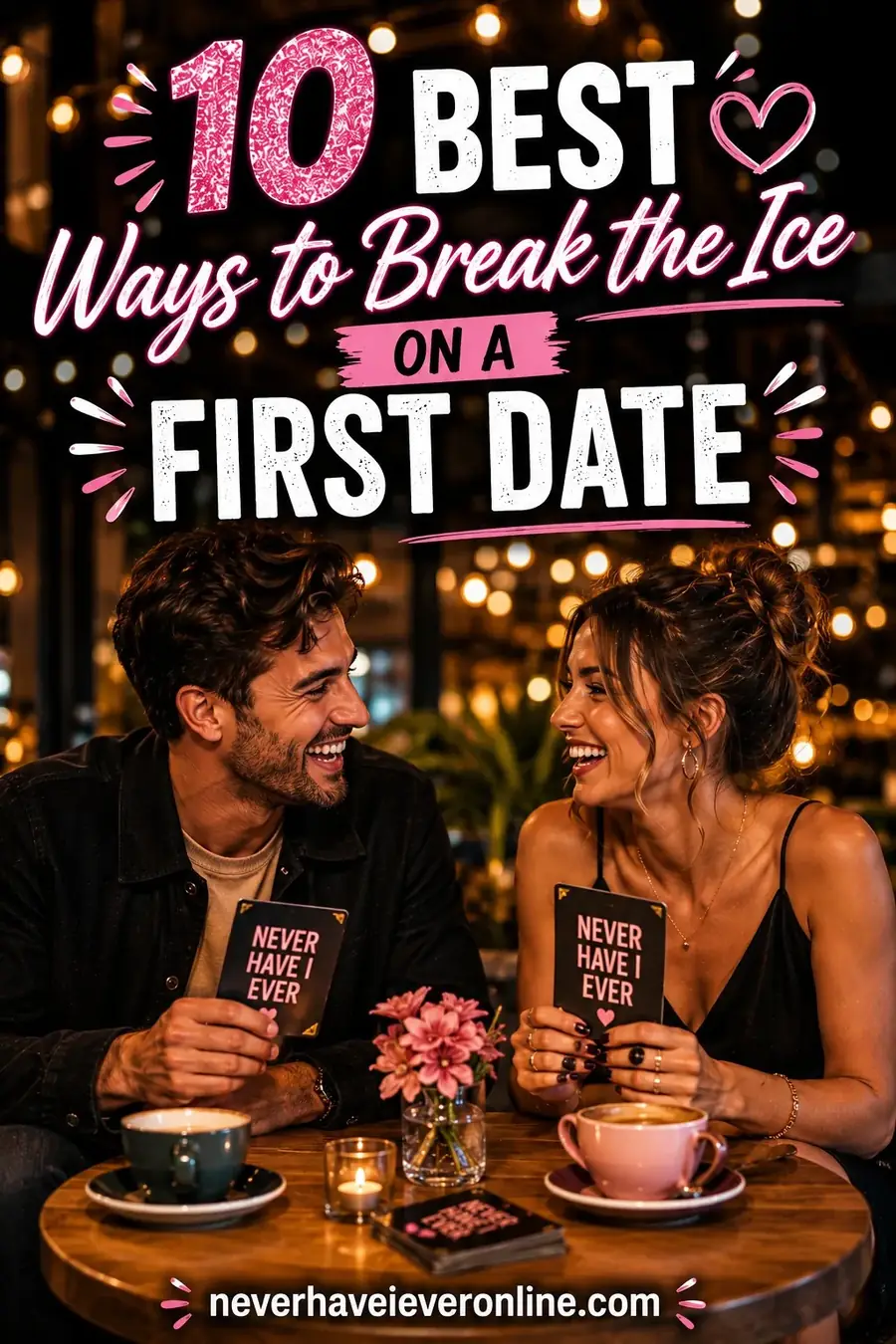
First dates are awkward because both people are performing. You're trying to seem interesting without seeming like you're trying. You're making conversation while also evaluating someone. You're present while also running calculations in your head.
The fastest way out of that mode is something external to focus on — a game, an activity, a question format that makes the conversation feel structured enough to relax into. The options below aren't tricks; they're just ways to remove the full weight of "entertain a stranger" from both people simultaneously.
Some of these take 30 seconds to set up. Some require a venue. All of them work better than staring at each other across a coffee table hoping something interesting comes up.
What Makes a Good First Date Icebreaker?
Reduces awkwardness without forcing it. The goal isn't to eliminate nerves — nerves are normal and actually signal interest. The goal is to give both people something to focus on so the nerves don't dominate.
Creates natural back-and-forth. The best icebreakers aren't one person talking while the other listens — they alternate. Anything structured around taking turns solves this automatically.
Reveals personality, not just biography. "What do you do?" tells you someone's job. "Would you rather never have to work again or have the most meaningful career imaginable?" tells you something about them. Preference and hypothetical questions get to character faster than résumé questions.
Keeps the energy light. A first date isn't the place for heaviness. The best icebreakers are fun first — depth can come later once you've both relaxed.
Has a natural ending. Open-ended icebreakers that never conclude create pressure. A game with rounds, a question deck with finite prompts, or an activity with a clear finish line removes the "when do we stop this?" awkwardness.
The List: 10 Best Ways to Break the Ice on a First Date
#1: Never Have I Ever Online — First Date Friendly Questions
Players: 2 | Setup: 0 min | Cost: Free
Never Have I Ever Online has lighter question modes that work perfectly for first dates — funny, personality-revealing, and not remotely as heavy as the party version's spicy edition. Questions like "Never have I ever canceled plans just because I didn't feel like going" or "Never have I ever pretended to like something to impress someone" land well because they're relatable, slightly self-deprecating, and invite the other person to respond in kind.
The format removes the burden of having to come up with interesting questions yourself. You're both reacting to the same prompt — which levels the playing field and makes the conversation feel more like a game than an interview.
Pull it up on your phone after you've ordered drinks. Play for 10–15 minutes. By the time you're done, you'll have laughed at least twice and learned a few things about each other that wouldn't have come up organically for another hour.
Best for: Dates where conversation hasn't quite taken off yet, or any first date that could use a low-stakes warm-up.
#2: Would You Rather Online
Players: 2 | Setup: 0 min | Cost: Free
Would You Rather takes the pressure of originality off both people. The app generates the dilemma; you just choose and defend. "Would you rather always say exactly what you're thinking, or never be able to speak again?" — now you're in a real conversation about communication, honesty, and personality, but it started with a silly binary choice.
The reveal isn't the answer — it's the reasoning. How someone defends a ridiculous hypothetical tells you a lot about how they think and what they value. It's surprisingly effective for a zero-setup digital game.
Best for: First dates where both people are comfortable with phones out, or a quick game before the conversation fully takes over.
#3: Two Truths and a Lie
Players: 2 | Setup: 0 min | Cost: Free
One person says two true things and one lie. The other guesses which is the lie. It sounds simple, and it is — but it's a remarkably effective format for revealing interesting things about yourself without it feeling like a presentation.
People almost always choose truths that are unexpected or unusual, because that's what makes the lie harder to spot. You end up learning things in two minutes that wouldn't have come up in a standard conversation for an hour.
Keep it to two or three rounds each so it doesn't wear out its welcome. Use it as a starter, not the whole date.
Best for: Coffee dates or any setting without an activity — gives both people something to do with the conversation.
#4: Play a Game at a Board Game Cafe
Players: 2 | Setup: 5 min (choose a game) | Cost: $10–20 (entry fee or drink minimum)
Board game cafes exist in most mid-sized cities, and they're excellent first date venues. You sit across from each other, you have something to focus on, there's natural competitive banter, and there's built-in conversation between turns.
Choose a game that takes 20–30 minutes max: Patchwork, Jaipur, Hive, or Sushi Go. Avoid anything with a 45-minute rulebook explanation — that's not a date, that's a tutorial.
Best for: First dates where you want more than just drinks but don't want the pressure of a full dinner.
#5: Mini Golf
Players: 2 | Setup: 0 min | Cost: $10–20
Mini golf is an underrated first date for one specific reason: it gives you something to focus on that isn't each other, which paradoxically makes it easier to be yourself around each other. The course provides conversation pacing — you talk between holes, you're briefly quiet during shots, you have something to react to ("that should not have gone in").
Mild competition with something low-stakes creates exactly the right energy for a first date. Nobody actually cares who wins.
Best for: Active dates for people who find sit-down conversation high-pressure.
#6: Cooking Class
Players: 2 | Setup: Book in advance | Cost: $50–100/person
A cooking class gives you a shared task, a shared instructor, and something to laugh at together when yours looks worse than the demo. You're not performing for each other — you're both focused on not overcooking the pasta.
The structured format removes the open-ended pressure of "make this work" that a dinner date carries. You have something to do, a time limit, and a meal at the end.
Best for: Second-date energy on a first date — best if you've already had one short date and want to escalate the format.
#7: Trivia Night — As a Team Against Other Tables
Players: 2 | Setup: Find a bar that hosts it | Cost: Varies (usually free to play)
Trivia nights at bars flip the dynamic of a first date: instead of evaluating each other, you're on the same team against everyone else. You celebrate the same answers, you compensate for each other's blind spots, and you get a clear read on how someone handles not knowing things (gracefully or not).
The team format accelerates the "we're in this together" feeling faster than sitting across a table from each other.
Best for: Dates who both mentioned they like trivia, or any date where shared competition sounds more comfortable than direct conversation.
#8: Escape Room
Players: 2 | Setup: Book in advance | Cost: $25–40/person
Escape rooms are intense first dates — which is either exactly right or entirely wrong depending on the people involved. You'll see how someone handles pressure, how they communicate when confused, and whether they're the kind of person who takes over or hangs back.
If it goes well, you leave with a shared story. If it doesn't, you at least know something real about each other quickly.
Best for: People who've been talking online for a while and want to fast-track the "how do we actually work together" question.
#9: The 36 Questions — Abbreviated Version
Players: 2 | Setup: 5 min (find the list) | Cost: Free
Arthur Aron's 36 Questions — the research-backed set designed to accelerate intimacy — works on first dates if you use just the first set. The early questions are light: "Given the choice of anyone in the world, who would you want as a dinner guest?" They feel more interesting than standard first-date questions without going anywhere heavy.
Don't attempt all 36 on a first date. The third set is designed for couples who've already built trust. Use 5–8 questions from Set 1 as conversation prompts, not the full protocol.
Best for: First dates where the chemistry is already there and you want to deepen it — not as an opener, but after you've warmed up.
#10: Walk and Talk — Activity Date That Reduces Pressure
Players: 2 | Setup: 0 min | Cost: Free
Walking side-by-side removes the eye contact pressure of sitting across from someone. Research actually supports this — people disclose more when they're not face-to-face. A 45-minute walk through a neighborhood, park, or waterfront gives you an organic date with natural pacing: you look at things together, react to your surroundings, and talk without performing.
Add a single destination (a coffee spot, a viewpoint, a good bakery) so there's structure. The walk is the date, not just the commute.
Best for: Introverts, people with date-night anxiety, or anyone who finds coffee shop conversation too static.
How to Choose
If you're meeting for the first time: Start with something light and in-person — mini golf, a board game cafe, or a walk. Activity dates reduce pressure and give you something to react to together.
If you're nervous about conversation: Pull up Never Have I Ever Online after you sit down. Ten minutes of prompted questions is easier than ten minutes of improvised dialogue.
If you want to see how they handle pressure: Escape room or trivia night — both reveal character quickly.
If you've already had good text/app chemistry: Cooking class or the 36 Questions (first set only). You've already done the warm-up; now you want something that goes a layer deeper.
If the date is going well and you want to extend it: Two Truths and a Lie, or transition from your activity into Never Have I Ever Online for the walk home or the after-drink.
If you want low cost and zero planning: Walk and talk, Two Truths and a Lie, or any of the free apps on this list.
❓ Frequently Asked Questions
What's the fastest way to break the ice on a first date?
Pull up Never Have I Ever Online on your phone after you've ordered drinks. It takes ten seconds to start and generates immediate laughter and honest reactions. You'll know within three prompts whether there's conversational chemistry.
Is it okay to play games on a first date?
Yes — especially digital games played together rather than on separate phones. Games that require both people to participate create shared moments, and shared moments are what make a first date memorable. The date is already a performance; giving it a structure makes the performance easier.
What should you never do to break the ice on a first date?
Ask rapid-fire biographical questions ("What do you do? Where did you grow up? Do you have siblings?"). It feels like an interview and creates a one-way dynamic. Preference questions, hypotheticals, and games generate more natural conversation than résumé questions.
How long should you use an icebreaker?
10–20 minutes max. An icebreaker is a launch pad, not the whole date. Once conversation is flowing naturally, put the phone down. The game has done its job.
What if the other person thinks games on a first date are weird?
Frame it casually: "I saw this thing where you answer random questions — want to try one?" Most people say yes when it's positioned as something fun you stumbled across rather than a planned activity. If they're genuinely against it, the walk-and-talk option requires nothing at all.