15 Best Team Bonding Activities That Actually Work
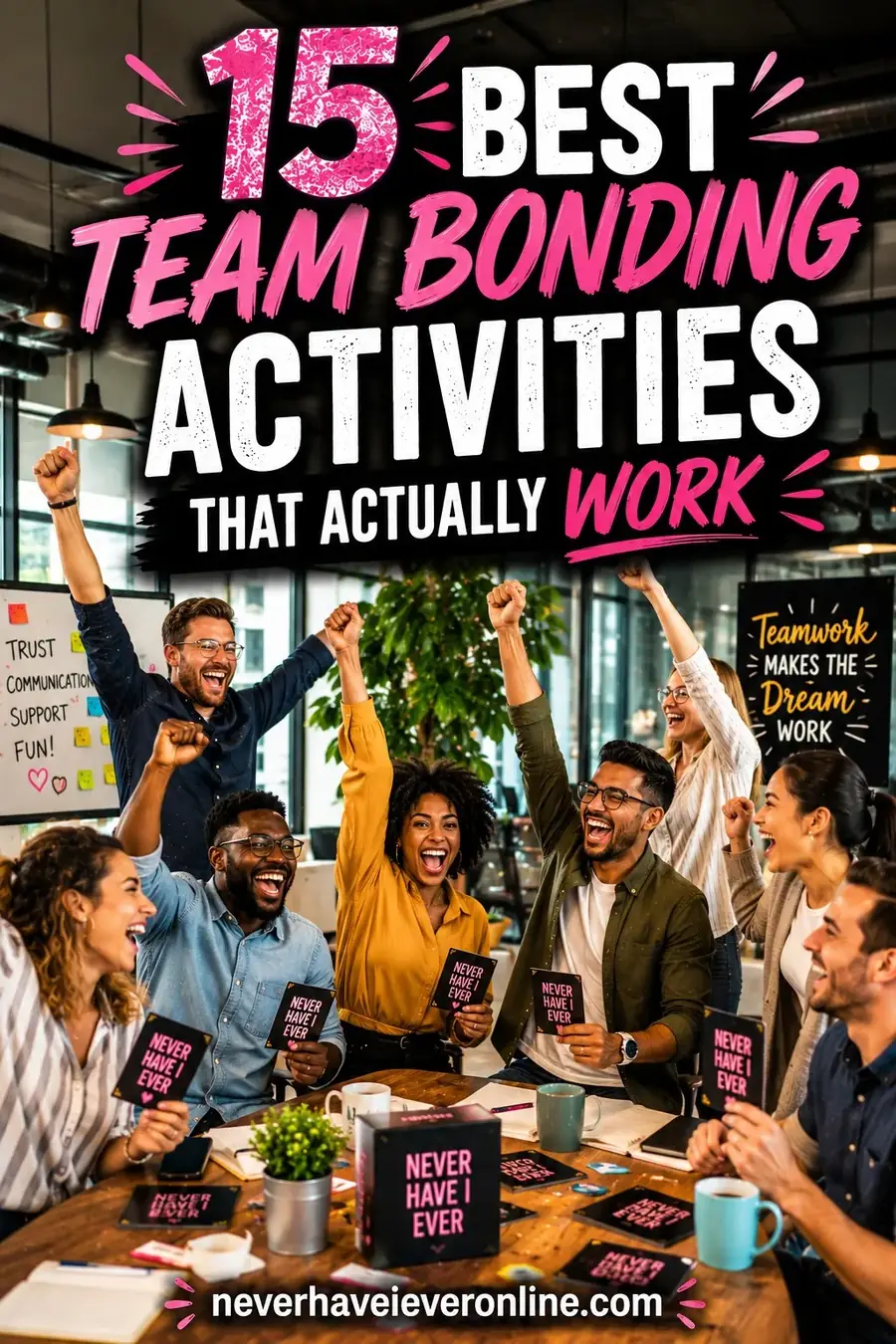
Most team bonding activities fail for the same reason: they feel mandatory. Trust falls, ropes courses, personality type workshops — the format signals "HR ordered this" before anyone even walks in the room. People participate just enough to avoid standing out.
The activities on this list work because they don't feel like team building. They feel like something you'd actually choose to do. A game, a challenge, a shared meal, an experience that creates a real memory. The bonding happens as a byproduct of doing something genuinely enjoyable together.
These 15 options cover in-person, virtual, budget-friendly, and splurge-worthy — there's something here for every team size and situation.
What Makes a Team Bonding Activity Actually Work?
Doesn't feel forced or cringe. The moment people sense they're being manipulated into bonding, they disengage. Activities that are genuinely fun on their own terms work; activities that are transparently therapeutic don't.
Includes everyone regardless of role or personality. Not everyone wants to be the loudest person in the room. Good bonding activities have space for quieter contributors, not just the ones who take charge.
Creates a shared memory. The best team bonding stories are still being told six months later. An activity that generates a moment — something funny, surprising, or genuinely impressive — outlasts anything forgettable.
Low barrier to entry. Activities with complex rules, required skills, or steep learning curves create in-groups and out-groups within the team. The best options are accessible from minute one.
Has a clear arc. A beginning, a middle, and an end — something happens, culminates, and finishes. Open-ended "mingle time" is not team bonding; it's just waiting.
The List: 15 Best Team Bonding Activities That Actually Work
#1: Never Have I Ever Online — Office/Work Edition
Players: 3–50+ | Setup: 0 min | Cost: Free
Never Have I Ever Online has an office and work edition built specifically for professional settings. The questions are workplace-appropriate and surprisingly revealing: "Never have I ever pretended to understand something in a meeting," "Never have I ever taken credit for someone else's idea by accident," "Never have I ever Googled something five minutes before presenting it as my expertise."
Everyone nods. Everyone laughs. Everyone realizes the person three desks over has done the exact same things they have.
The format works especially well for larger teams because it scales infinitely — one screen, one projector, and everyone plays simultaneously. It also works for remote and hybrid teams without any special software: just share a screen and read the prompts aloud. No account, no download, no facilitation needed.
It's consistently one of the most-returned-to team activities precisely because it's not trying to be team building. It's trying to be fun. The bonding is a side effect.
Best for: Any team size, any setting — in-person or remote, 5 people or 50.
#2: Would You Rather Online
Players: 3+ | Setup: 0 min | Cost: Free
Would You Rather translates directly to team settings. Put a question on the main screen and have everyone vote — then hear from the minority. Why would anyone rather give up coffee than social media for a month? The reasoning is the conversation.
It works as a meeting warm-up, a lunch break activity, or the opener before a longer team event. The debate format is particularly good for teams that already know each other — it reveals opinions and values you wouldn't get from a standard check-in.
Best for: Warm-ups, all-hands icebreakers, or distributed teams with screen sharing.
#3: Escape Room
Players: 4–10 per room | Setup: Book in advance | Cost: $25–40/person
Escape rooms are one of the few activities that genuinely test team dynamics in a low-stakes way. You'll see who takes charge, who finds things others miss, who panics under time pressure, and who's unexpectedly good at lateral thinking. Then you leave and laugh about all of it.
Book private rooms so your team isn't mixed with strangers. Choose a difficulty level below "recommended" — the goal is a win that feels earned, not a frustrating loss that sours the memory.
Best for: Teams of 4–10 who want a structured challenge with a clear narrative arc.
#4: Volunteer Day
Players: Any size | Setup: 2–4 weeks ahead | Cost: Free (to the team)
A half-day volunteering at a food bank, habitat build, or community garden creates a shared sense of purpose that no internal activity can replicate. People work together on something real with visible outcomes — and they leave feeling better than when they arrived.
The key is choosing something physically active rather than administrative. Sorting donations, building something, planting something — these create natural conversation and a sense of accomplishment. Scheduling a group lunch after extends the momentum.
Best for: Teams that care about company values beyond the internal — also strong for external visibility and recruiting.
#5: Trivia Night
Players: 8–50 | Setup: Hire a host or use an app | Cost: Free–$500 (depending on hosted vs. DIY)
Divide the team into mixed groups — not the groups they already work in — and run a trivia competition. Themed rounds (company history, pop culture, general knowledge) keep everyone engaged across different knowledge bases.
The cross-functional mixing is the key. People who rarely interact end up on the same team, celebrating the same answers. Rivalries form between groups. A genuine winner emerges. It's competitive without being physical and social without requiring charisma.
Best for: Medium to large teams (15–50) who want something structured with a competitive arc.
#6: Cooking Class
Players: 8–30 | Setup: Book 2–3 weeks ahead | Cost: $60–120/person
A group cooking class gives teams a shared task, a time constraint, and a meal at the end. People who've worked together for years discover they're surprisingly good (or bad) at pasta-making. The kitchen environment is collaborative by design — you're all making the same thing, so success is genuinely shared.
Choose classes that involve hands-on prep rather than demonstration-heavy formats. The talking happens while people are doing.
Best for: Teams that want a premium experience with a built-in social meal.
#7: Improv Workshop
Players: 8–25 | Setup: Hire a facilitator | Cost: $500–2,000+ for a professional session
Improv workshops are underused in corporate settings and almost always land better than expected. The core exercise — "yes, and" — directly mirrors collaborative communication. People get out of their heads, make each other look good, and laugh at themselves.
A good improv facilitator extracts the professional applications without making it feel like training. The best sessions feel like 90 minutes of comedy with 10 minutes of insight at the end.
Best for: Teams that need better real-time communication, or organizations dealing with siloed thinking.
#8: Scavenger Hunt
Players: Any size | Setup: Plan or hire a company | Cost: Free (DIY) to $2,000+ (professional)
Divide into mixed teams and send them on a city-wide or office-wide scavenger hunt. Modern versions are app-based — teams submit photo proof of completed challenges and compete for points in real time.
The hunt format creates cross-functional collaboration, mild competition, and natural storytelling. Teams that barely interact during the workday have to coordinate, problem-solve, and probably take some ridiculous photos together.
Best for: Companies in walkable cities with the budget for a vendor, or creative teams who want to DIY it.
#9: Murder Mystery Dinner
Players: 8–40 | Setup: Purchase a kit or hire a company | Cost: $15–50/person (kit) or $50–100/person (hosted)
Murder mystery dinners combine a shared meal with a structured game — everyone plays a character, everyone has information, and someone at the table did it. The format forces interaction across the whole group rather than letting people cluster with their usual colleagues.
Kits are available for self-hosting; companies that run professional events exist in most cities. The theatrical element — playing a character — removes the "this is work" feeling more completely than almost any other activity.
Best for: Teams that want something memorable and slightly theatrical, especially for off-site dinners.
#10: Bowling
Players: 6–20 | Setup: Book lanes in advance | Cost: $15–25/person
Bowling gets dismissed as generic, but it works reliably because the format is social by design. You play in bursts — one person's turn, everyone else watches — and the game provides constant reaction fodder regardless of skill level. Terrible bowlers are often more entertaining than good ones.
Add a small prize, a food order, and minimal competitive pressure and you've got an evening that people actually remember. Keep it simple.
Best for: Teams that want guaranteed fun without requiring anyone to be brave, creative, or physically capable.
#11: Hackathon or Build Challenge
Players: 8–40 | Setup: 2–4 weeks | Cost: Low
Give cross-functional teams a 4–8 hour window to build something, pitch something, or solve a specific problem — then present to a panel. The output can be a product idea, a process improvement, or something playful (a company-themed game, a team website).
The format rewards lateral thinking and cross-functional collaboration in a way that everyday work doesn't. It also surfaces unexpected talent — the finance person who builds the best pitch deck, the designer who turns out to be the sharpest strategist.
Best for: Product, tech, or creative companies with a culture of experimentation.
#12: Charity Drive
Players: Any size | Setup: 2–3 weeks | Cost: Low (logistics only)
Organize a team-wide charity drive — food, clothing, school supplies, books — with a collective goal. Create visible progress tracking. Celebrate hitting the goal together.
The shared purpose creates genuine team cohesion without requiring anyone to be physically present at the same time. It also works as a multi-week bonding arc rather than a single event.
Best for: Distributed teams, large organizations, or companies where a single in-person event isn't feasible.
#13: Virtual Coffee Roulette
Players: Any size | Setup: Use a Slack app (Donut) or manual pairing | Cost: Free
Pair team members randomly for 20-minute virtual coffees every two weeks. No agenda — just two people getting to know each other. Tools like Donut (Slack integration) automate the pairing.
This is the quietest activity on the list but consistently one of the most effective over time. Relationships form in 1:1 settings that don't form in group settings. Over three months, everyone on a 20-person team has met everyone else.
Best for: Remote or hybrid teams as a long-term culture investment rather than a single event.
#14: Sports Day
Players: 20–100 | Setup: 3–4 weeks | Cost: $20–50/person
An outdoor sports day — relay races, three-legged races, tug-of-war, giant Jenga — hits differently than a gym-based activity because the format is inherently silly. Nobody takes field day events seriously, which removes hierarchy and creates equal-opportunity embarrassment.
The physicality generates energy that indoor activities rarely do. Pair it with food and it becomes a full-day event with natural conversation pockets.
Best for: Large teams (30+) where you need an activity that scales and creates visible shared energy.
#15: Pottery or Art Class
Players: 6–20 | Setup: Book in advance | Cost: $40–80/person
A pottery or art class gives everyone the same learning curve — regardless of experience. Nobody walks in knowing how to throw a bowl. The shared incompetence creates laughter, vulnerability, and a surprising amount of conversation.
People leave with something physical they made — which becomes its own conversation point for weeks. "I made this" is a better memory than "we went to a restaurant."
Best for: Teams that skew creative, or any group that wants something visually memorable.
How to Choose
For in-person teams of any size with zero budget: Never Have I Ever Online — load it on a laptop, connect to a TV, and play. Done in five minutes flat.
For remote or hybrid teams: Never Have I Ever Online (screen share), Would You Rather Online, or Virtual Coffee Roulette. All three work over video without special software.
For small close-knit teams: Escape room or cooking class — both work best when everyone's genuinely engaged, not just present.
For large teams (30+): Trivia night, sports day, or a charity drive. Scale matters — choose formats that don't require small group dynamics to work.
For teams with tight budgets: Bowling, scavenger hunt (DIY), charity drive, or the free digital games.
For teams that need more than fun: Improv workshop or hackathon — both build skills while also being enjoyable.
❓ Frequently Asked Questions
What's the best team bonding activity for remote teams?
Never Have I Ever Online is the strongest starting point — it requires nothing but a shared screen and generates immediate laughter without anyone needing to be particularly outgoing. Virtual Coffee Roulette is the best long-term investment for distributed teams.
What team bonding activities don't require a big budget?
Never Have I Ever Online, Would You Rather Online, Two Truths and a Lie, a self-run scavenger hunt, bowling, and volunteer days are all low-cost or free. The budget isn't what determines whether bonding happens — the format and energy do.
How long should a team bonding activity last?
Two to three hours is the sweet spot for most activities. Long enough to actually relax into it; short enough that nobody resents the time commitment. Half-day events work well when there's a meal included. Full-day events require significantly more energy management.
What if some team members don't want to participate?
Low-barrier, low-stakes activities reduce opt-outs. Games with no physical requirement, no performance pressure, and no single point of failure — like Never Have I Ever Online or trivia — tend to get higher participation than anything that requires bravery or visible skill.
How often should teams do bonding activities?
One substantial activity per quarter plus lighter touchpoints monthly. Quarterly events maintain the relationship; monthly touchpoints (coffee roulette, a warm-up game before a meeting) keep the connections alive between events.
What's the one activity that works every time?
Never Have I Ever Online's office edition. It's free, scales from 3 to 300, works remotely, requires no facilitation, and generates genuine laughter in the first five minutes. It's the activity most teams ask to repeat.