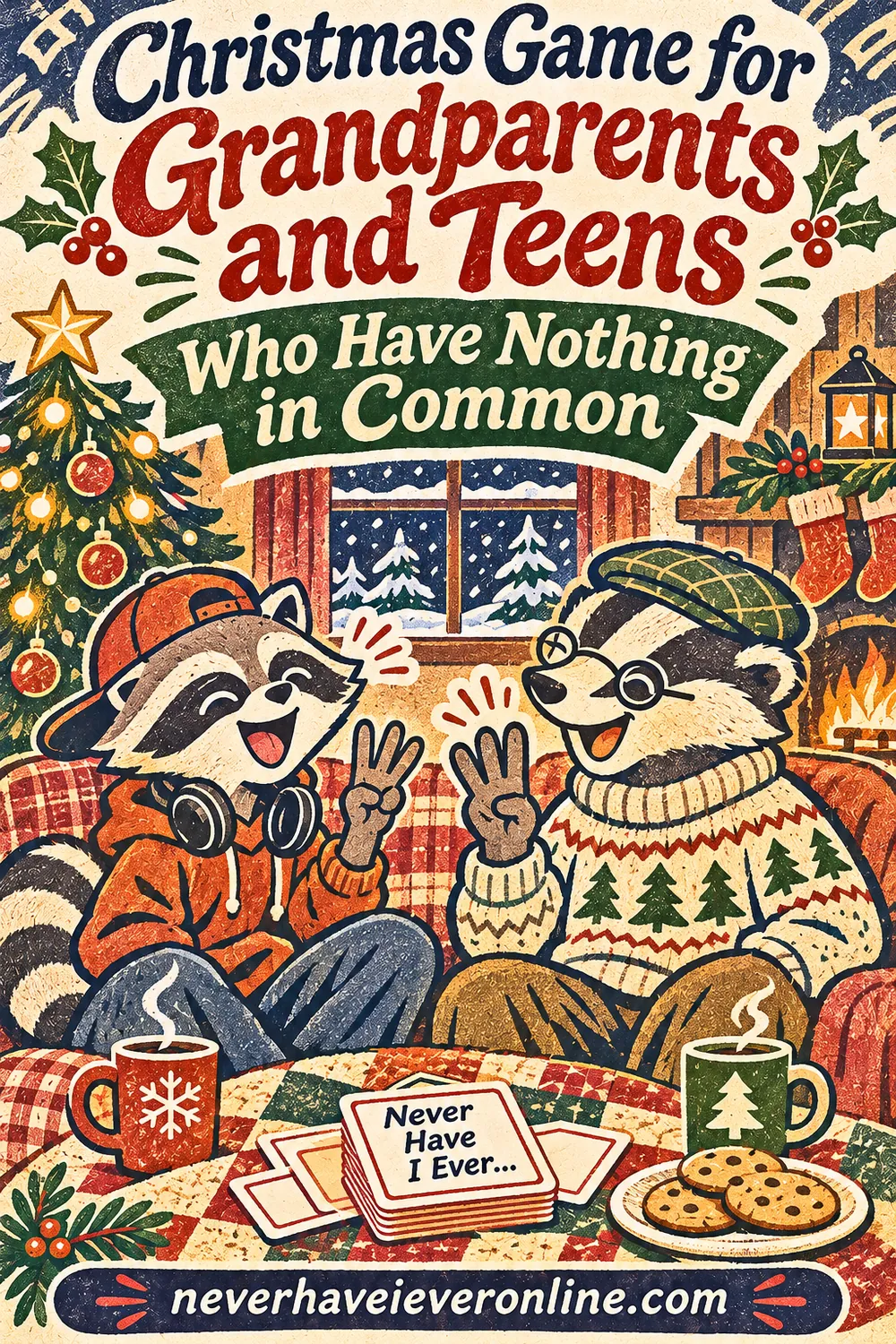
Christmas Game for Grandparents and Teens Who Have Nothing in Common
🎮 Play a round with this list
Read it out. Anyone who has done it puts a finger down.
The game that finally works for grandparents and teens together is Never Have I Ever played with clean, life-experience statements: "Never have I ever gotten lost in a new town" or "Never have I ever been sent to the principal's office" gives a 15-year-old and a 75-year-old the same shot at a story. There's no trivia, no slang, no apps to learn and no pop culture to know. Open the free Never Have I Ever online game, pick Christmas or Family, choose Clean & Fun, and read the first card out loud.
The trick isn't the game itself. It's picking statements about things people do, not things people watch or know. Below you'll find the exact settings, 48 bridge statements that work across 60 years of age difference, a follow-up method that turns a dropped finger into a real conversation, a game plan for the day, and fixes for the eye rolls and the "I don't get it" moments.
Why Grandparents and Teens Struggle to Find a Shared Game
Most Christmas games quietly pick a side. Trivia about recent shows or music leaves older relatives guessing. Trivia about old shows or music leaves teens checked out. Fast-paced card games with a lot of rules frustrate people who learned to play cards 60 years ago with completely different rules. Video games need controllers and practice. Physical games are hard on knees and backs.
So families end up with two separate Christmases in one house. The teens are on the couch with their phones. The grandparents are at the kitchen table with coffee. Parents bounce between them, trying to get everyone into one room.
The thing teens and grandparents do share is the experience of being a person. Both have had a first day at a new school. Both have been embarrassed in front of a whole class. Both have gotten in trouble for something a sibling did. Both have tried to cook something and burned it. The details are wildly different, and that's what makes it fun. A teen who dropped a finger for "Never have I ever gotten lost" because a map app sent them the wrong way is suddenly hearing how Grandpa got lost in a city with a paper map and a gas station attendant's directions.
Never Have I Ever turns those shared experiences into a game. Everyone holds up ten fingers, one person reads a statement, and anyone who has done it puts a finger down. The statement is the same for everyone. Only the stories are different.
Games that split generations, and why
| Game type | Who usually gets left out | Why |
|---|---|---|
| Pop-culture trivia | Grandparents or teens, depending on the decade | Knowledge is tied to when you grew up |
| Fast card games with new rules | Older relatives | Too many rules to learn in one sitting |
| Video games | Older relatives | Controllers and practice required |
| Old-school card games | Teens | Long rounds and rules they've never seen |
| Active or physical games | Older relatives with sore knees or backs | Hard on the body |
| Life-experience statements | Nobody | Everyone has lived through firsts, mistakes and holidays |
What makes a statement ageless
A good cross-generation statement passes three tests:
- Both ages can answer it honestly. "Never have I ever been nervous on the first day of school" works. "Never have I ever retired" doesn't.
- It doesn't depend on technology or trends. "Never have I ever gotten lost" works. "Never have I ever lost my phone signal on a road trip" leaves out people who grew up before cell phones.
- The story is better than the answer. The best cards make people ask "When? Where? What happened?" right after the finger goes down.
How to Do It With the Free Tool
Here are the exact taps. The setup takes about a minute, and you can do it while people are still finding seats.
Step 1: Open the game and pick your theme
Open the free Never Have I Ever game in any browser on a phone, tablet or laptop. There's nothing to install and no account to create. The first screen says "Pick your theme" and shows a "Just Play" button, then three groups: Occasions, Who's In The Room, and Holidays.
For a mixed-age Christmas, you've got two strong choices:
- Christmas (under Holidays) mixes holiday statements, like peeking at presents or falling asleep during a Christmas movie, with everyday statements about common mishaps. It's festive, and the everyday cards keep it fair for relatives who aren't big on holiday traditions.
- Family (under Who's In The Room) is all about family life: blaming a sibling, hiding food so nobody else gets it, pretending to be asleep to dodge chores, and being the last to hear family news. These cards are gold for grandparents and teens, because every generation has done them, and the grandparents usually did them to the very parents sitting at the table.
Start with Christmas for round one. Play Family in round two.
Step 2: Choose Clean & Fun
The next screen asks "What's the vibe?" Tap Clean & Fun, which the site describes as safe for all ages, including family, kids and coworkers. Then tap Let's play!
When you pick the Family theme, the game hides the Deep & Personal vibe and only shows the lighter options, so you can't land on heavier cards by accident. The same is true for the Teenagers, Tweens and Kids themes, which the site treats as family-safe.
Skip Deep & Personal for the full group. In the Christmas theme, some of those cards are about missing someone during the holidays. That's a tender subject at a multi-generation table, where grandparents may be thinking about friends and siblings they've lost. If a grandparent and an older teen end up talking quietly later, that conversation can happen on its own.
Step 3: Make the card easy to see
Older eyes and a small phone screen don't mix. Two ways to fix that:
- Read aloud. The reader holds the phone and reads every card clearly, with the full "Never have I ever..." opening.
- Use Party mode. At the top of the game screen, tap Party mode. It fills the screen with the card in large text and sizes the words to fit. Connect a laptop or tablet to the TV, turn it on, and everyone can read along from their chair. Press Escape or tap Exit to leave it.
Step 4: Play the card, then ask the follow-up
Read the card. Fingers go down. Then, instead of moving on right away, ask one quick question that connects the two generations. More on that below in the follow-up method. When you're ready, tap the card or Next. Use Prev to go back one.
Under the card, small text shows where you are in the round, like "Question 3 of 16."
Step 5: End the round and switch it up
A round is about 15 to 17 cards. At the end you'll see "Round Complete!" with two buttons: Play Again, New Questions for a fresh set in the same theme, or Choose Another Theme to switch, for example from Christmas to Family. The game also remembers, on that device, which cards you've already played, so a second Christmas get-together later in the week starts with cards you haven't seen.
Settings by group
| Your group | Round 1 | Round 2 | Who reads |
|---|---|---|---|
| Grandparents, teens and parents | Christmas, Clean & Fun | Family, Clean & Fun | A teen |
| Grandparents, teens, and young kids | Christmas, Clean & Fun | Family, Clean & Fun | Rotate, with help for little readers |
| Just one grandparent and one or two teens | Family, Clean & Fun | Just Play, Clean & Fun | Take turns |
| Big extended family, 12 or more | Christmas on the TV in Party mode | Family on the TV | One host |
| Teens who want something sillier | Christmas, Funny & Silly | Family, Clean & Fun | A teen |
🎄 Play hundreds more Never Have I Ever statements free online, no download needed
▶️ Play Free Now48 Bridge Statements Teens and Grandparents Can Both Answer
The game deals its own cards, and those are a great starting point. But when you've got a grandparent and a teenager at the same table, it helps to have a few statements built to bridge the gap. Mix these in between game cards, or read a handful when you want to aim at a particular pair.
Read each as "Never have I ever..." followed by the line.
School days
- Been sent to the principal's office.
- Fallen asleep in class.
- Been the new kid at school.
- Forgotten my lines in a school play.
- Copied a friend's homework.
- Had a teacher I was a little afraid of.
- Been picked last for a team.
- Won a school award or ribbon.
Firsts
- Had a first job I didn't like.
- Cooked a whole meal by myself.
- Driven a car in the snow.
- Gotten lost in a new town.
- Flown on an airplane.
- Gone to a dance and stood by the wall the whole time.
- Slept away from home for a whole week.
- Stayed up all night talking with a friend.
Family life
- Blamed a sibling for something I did.
- Gotten in trouble for laughing at the wrong time.
- Eaten a food I hated just to be polite.
- Pretended to be asleep so I didn't have to help.
- Been grounded or lost a privilege.
- Shared a bedroom with a brother, sister or cousin.
- Been the one in the family everyone calls for help.
- Had a nickname I didn't choose.
Christmas and winter
- Peeked at a present before Christmas.
- Built a snowman.
- Gotten a gift I didn't understand.
- Made a homemade gift for someone.
- Been in a Christmas pageant or holiday program.
- Gone caroling.
- Slept in on Christmas morning.
- Had a snow day off from school.
Mishaps and moments
- Broken a bone.
- Locked myself out of the house.
- Walked into a glass door.
- Forgotten someone's name right after meeting them.
- Waved back at someone who was waving at somebody else.
- Laughed so hard I cried.
- Fallen asleep during a movie I picked.
- Tripped over absolutely nothing.
Big feelings, kept light
- Made a friend in one day.
- Been nervous before a big performance or game.
- Written a letter by hand.
- Kept a diary or journal.
- Moved to a new house or town.
- Helped a total stranger.
- Learned a skill from a grandparent.
- Been proud of something nobody else noticed.
Why these work across generations
Look at number 13, "Flown on an airplane." A 16-year-old might have flown for a family vacation. A 78-year-old might remember their first flight as a huge event, with dressing up for it. Same finger, completely different story. Number 43, "Written a letter by hand," flips the usual script. Grandparents drop a finger without thinking, and teens often don't, which leads to the funny question of how they've ever thanked anyone for a gift.
That reversal is the secret ingredient. Some cards are easier for teens, some are easier for grandparents, and nobody is "behind" for long.
For more ageless ideas, the site's Never Have I Ever for seniors page has gentle statements about life experience, and the questions for teens page has everyday statements teenagers relate to. Pick a few from each and you've got a custom family list.
The Follow-Up Method: Turning a Finger Into a Conversation
Here's where this game goes from "fine" to "the best part of Christmas." After a card, if both a teen and a grandparent drop a finger, the reader asks one quick follow-up that puts the two stories side by side. We'll call it "then and now."
The four follow-up questions
Keep these four on a sticky note by the reader. Use one per card, at most.
| Follow-up | Example card | What it sparks |
|---|---|---|
| "How old were you?" | Driven a car in the snow | A teen who just learned and a grandparent who learned 60 years ago compare notes |
| "What was it like back then?" | Been the new kid at school | Grandparent describes a one-room or small-town school, teen describes a big one |
| "Who were you with?" | Stayed up all night talking with a friend | Both describe a best friend, and often the stories line up |
| "Would you do it again?" | Been sent to the principal's office | Big laughs, and grandparents often confess the most |
How it sounds at the table
Here's a typical exchange, so you can picture the rhythm.
The reader, a 14-year-old, reads: "Never have I ever had a first job I didn't like."
Grandma drops a finger. Dad drops a finger. The 17-year-old drops a finger.
The reader asks: "Grandma, how old were you?"
Grandma says she was 15 and picked strawberries all summer, and her back hurt for a week. The 17-year-old says they bag groceries on weekends and their feet hurt for a week. Everybody laughs. Dad says he scooped ice cream and gained ten pounds. Two minutes, three generations, one shared experience. Then the reader taps Next.
That's it. You don't need anything deeper than that. The conversation is the prize.
Scripts for starting the game
For a teen reader:
"Okay, everyone hold up ten fingers. Grandpa, you too. I'm going to read something. If you've done it, put one down. And if you put one down, you might have to tell us about it."
For a parent hosting:
"We're going to play a game that's half game and half story time. Teens versus grandparents, let's see who's done more. Ten fingers up."
Framing it as "teens versus grandparents" is a fun hook. It gives teens a team to root for and makes grandparents feel like they've got a team too. Nobody actually needs to keep a team score, but people love having a side.
Scripts for gentle encouragement
When a grandparent hesitates to share:
"Grandpa, you dropped a finger on that one. You've got to tell us now."
When a teen is quiet:
"You're the only one who didn't drop a finger. What's your secret?"
Asking someone about a finger they didn't drop is a low-pressure way to bring them in. It's a compliment, not an interrogation.
A Game Plan for a Mixed-Age Christmas Gathering
Here's how to fit the game into a real Christmas Day or extended-family gathering, with a worked example.
A worked example: eleven people, ages 8 to 82
The family:
- Two grandparents, 79 and 82
- A great-aunt, 74
- Three parents and an uncle, 44 to 52
- Three teens, 13, 15 and 17
- One 8-year-old cousin
Here's what the day looks like with the game in it.
| Time | What happens | Roles |
|---|---|---|
| 2:00 | Christmas dinner is cleared, dessert waits in the kitchen | Everyone |
| 2:10 | The 17-year-old connects a laptop to the TV, opens the game, picks Christmas and Clean & Fun, and turns on Party mode | Teen as tech lead |
| 2:15 to 2:35 | Round 1: Christmas, about 16 cards. The 15-year-old reads. Parents ask follow-ups. | Teen reader, parent host |
| 2:35 to 2:45 | Dessert break. Grandparents pick the next theme. | Grandparents decide |
| 2:45 to 3:05 | Round 2: Family, about 17 cards. The 13-year-old and the 8-year-old take turns reading, with help. | Younger readers |
| 3:05 | The 82-year-old is named Story Champion for the best story of the day. | Everyone votes |
| 3:10 | Teens are free. Some stay to keep talking, and that's the sign it worked. |
Some quick numbers on timing: each card takes about 20 seconds to read and count. A follow-up question with a short answer adds about a minute. If you do follow-ups on about half the cards, a 16-card round runs about 12 to 15 minutes. Add a couple of longer stories and you're at 20. Two rounds and a break fill about an hour, which is the right length before energy dips.
Give everyone a job
The surest way to keep both generations engaged is to give each one a role.
- Teens are the tech crew and readers. Connecting the laptop, running Party mode and reading cards gives teens ownership. It's their game now, not something their parents forced on them.
- Grandparents are the story judges. At the end of each round, they pick the best story of the round. It makes them the heart of the game instead of the guests.
- Parents are the follow-up askers. They know both generations best and can aim the "then and now" questions.
- Little kids are Next-button pressers. They tap Next or Prev and count fingers. Very important work.
Small Adjustments That Make It Work for Every Age
A mixed-age table has a few practical needs: older relatives may have trouble hearing or seeing, teens may need a reason to care, and everyone's energy runs out at different times. These tweaks handle all three.
| Need | Adjustment | How to do it |
|---|---|---|
| Trouble hearing | Read slowly and face the person | The reader sits across from the grandparent, not beside them. Repeat the card once. |
| Trouble seeing a phone | Big text on a TV | Turn on Party mode on a laptop connected to the TV. |
| Arthritis or stiff hands | Skip fingers | Use ten small candies, coins from a board game, or tally marks on paper instead. |
| Teens feel it's babyish | Give them control | Let them run the tech, read the cards and pick round two. |
| Teens want something funnier | Add one silly round | Christmas with Funny & Silly has cards about wrapping a gift so badly you apologized. |
| Young kids fade fast | Five fingers instead of ten | They stay in the game until the end. |
| Grandparents tire after an hour | Keep it to two rounds | End on a high note and let conversations continue on their own. |
| Someone feels left out | Ask about a finger they didn't drop | "You're the only one who's never done that. How?" |
Getting teens to actually play
Teens roll their eyes at anything that feels like a forced family activity. Three things change that.
First, don't call it a family game. Call it "teens versus grandparents" and let the teens be the team to beat.
Second, hand over the phone. Being the reader is a position of power. A teen who controls the pace, decides when to tap Next, and gets to watch Grandpa squirm over a principal's office question is having a good time.
Third, keep it short. Promise two rounds, about 40 minutes, and then keep your word. Teens who know there's an end in sight relax and play. And many of them stay longer on their own once the stories start.
Helping grandparents feel included
Grandparents often feel like guests at their own family's Christmas. The game flips that. Their stories are usually the oldest, the strangest and the funniest at the table. A few ways to put them in the spotlight:
- Ask follow-ups to grandparents first. Their answers set the "then" side of every "then and now."
- Make them the judges for Story Champion at the end of each round.
- Aim one card per round right at them. If you know Grandma was a champion speller, try "Never have I ever won a spelling bee."
- If a grandparent tells a long story, let it run. That's the moment your teens will remember.
The site's family reunion edition has more statements built for big, multi-generation gatherings, and the game variations page explains other scoring styles, like treat counters and team play, that work well when fingers are hard to hold up.
Troubleshooting Mixed-Age Game Time
Here's what tends to go wrong when generations play together, and how to fix it on the spot.
| Problem | Quick fix |
|---|---|
| A grandparent says "I don't understand the game" | Show, don't explain. Read the first card, drop your own finger, and say "Like that." |
| A teen refuses to play | Make them the reader. Most teens who won't play will happily run the game. |
| A card mentions something one generation doesn't know | Tap Next. The reader can skip any card without explanation. |
| Grandparents drop more fingers and teens feel they're losing | Switch to reverse scoring: score a point for each thing you HAVE done. Or remind everyone it's about stories, not winning. |
| Teens drop more fingers on funny cards | That's great. Ask the grandparents, "What's the old-school version of that?" |
| Stories run too long and teens drift | Use a one-follow-up-per-card rule, and gently say "Let's hear one more, then Next." |
| Someone gets emotional on a card | Pause, thank them, and move gently to the next card. Clean & Fun keeps this rare. |
| The phone screen is too small | Turn on Party mode and connect to the TV, or have the reader read every card twice. |
| The same cards come up again | The game remembers played cards on that device, so new rounds start with unseen ones. You can also switch themes. |
| Only one or two people are talking | Use the follow-up "You're the only one who didn't drop a finger. How?" to bring in someone quiet. |
| A grandparent can't hold up fingers | Use candies, buttons or tally marks for everyone, so nobody is singled out. |
When a card touches a sore spot
Families carry history. A card about moving, school or a family argument might bring up something sensitive for one person. The reader's skip rule handles most of this before it happens. If a card lands awkwardly anyway, the simplest fix is to say, "Let's skip that one," tap Next, and keep the energy moving. Nobody needs an explanation, and the game moves on in seconds.
Bring the Generations Together This Christmas
You don't need a perfect game or a shared favorite show to connect a teenager and a grandparent. You need statements about things people have actually lived through, one good follow-up question, and a reason for everyone to sit at the same table for 40 minutes. Open the free Never Have I Ever game, pick Christmas, choose Clean & Fun, hand the phone to a teen, and ask Grandpa to hold up ten fingers. Somewhere around the third card, you'll hear a story nobody in the room has heard before.
Quick Draw List: 16 Statements to Start With
Read these straight from the page, or tap the draw button at the top to get one at random.
- Never have I ever gotten lost in a new town.
- Never have I ever had a nickname I didn't choose.
- Never have I ever been sent to the principal's office.
- Never have I ever learned to drive in the snow.
- Never have I ever had a first job I didn't like.
- Never have I ever stayed up all night talking with a friend.
- Never have I ever written a letter by hand.
- Never have I ever been in a school play.
- Never have I ever cooked a whole meal by myself.
- Never have I ever broken a bone.
- Never have I ever moved to a new school.
- Never have I ever built a snowman.
- Never have I ever gotten in trouble for laughing at the wrong time.
- Never have I ever made a friend in one day.
- Never have I ever forgotten someone's name right after meeting them.
- Never have I ever slept in on Christmas morning.
🎮 Ready for the next round? Let the free game pick the next statement for you
▶️ Play Never Have I Ever❓ Frequently Asked Questions
What's a good Christmas game for all ages, from grandparents to teens?
Never Have I Ever with clean, life-experience statements works across generations because it doesn't depend on trivia, technology or pop culture. Everyone has had first days, mishaps and holiday memories. With the free online game, pick Christmas or Family and the Clean & Fun vibe, and everyone plays every card at the same time.
Which theme should I pick for a mixed-age group?
Start with Christmas for round one, since it mixes festive statements with everyday ones. Then switch to Family for round two. The Family theme is built for all ages, so the game only shows the lighter vibes when you pick it, and its statements about siblings, chores and sneaking food get every generation laughing.
Do grandparents need a phone or any tech skills to play?
No. Only one person needs a device, and that person reads the cards aloud. Everyone else just listens and uses their fingers. If eyesight is a concern, put the game on a TV with Party mode, which shows the card in large text.
How do I keep teens from rolling their eyes?
Give them a job. Teens make great readers and tech leads, and running the game gives them a sense of control. Framing it as "teens versus grandparents" and promising a set end time, like two rounds, also helps a lot.
Is the game appropriate for a family with young kids too?
Yes, with the Clean & Fun vibe, which the site describes as safe for all ages. Little kids can start with five fingers instead of ten so they stay in the game. The reader can skip any card that doesn't suit your family by tapping Next.
What if a grandparent can't hold up their fingers comfortably?
Switch the whole table to counters, like ten small candies, buttons or tally marks on paper. Changing it for everyone means no one feels singled out. Treat counters are a big hit with kids, too.
How long should we play?
Plan on two rounds, about 15 to 20 minutes each with follow-up stories, plus a short break. That's roughly 40 minutes to an hour, which fits between dinner and dessert or after gifts. Stop while people are still laughing, and let the conversations keep going on their own.
Can we play again later in the holidays without repeating cards?
Yes. The game remembers which cards you've played in each theme on that device, so later rounds start with cards you haven't seen. You can also tap Play Again, New Questions at the end of any round for a fresh set, or pick a different theme.