How to Play Never Have I Ever: Complete Rules, Versions & Tips
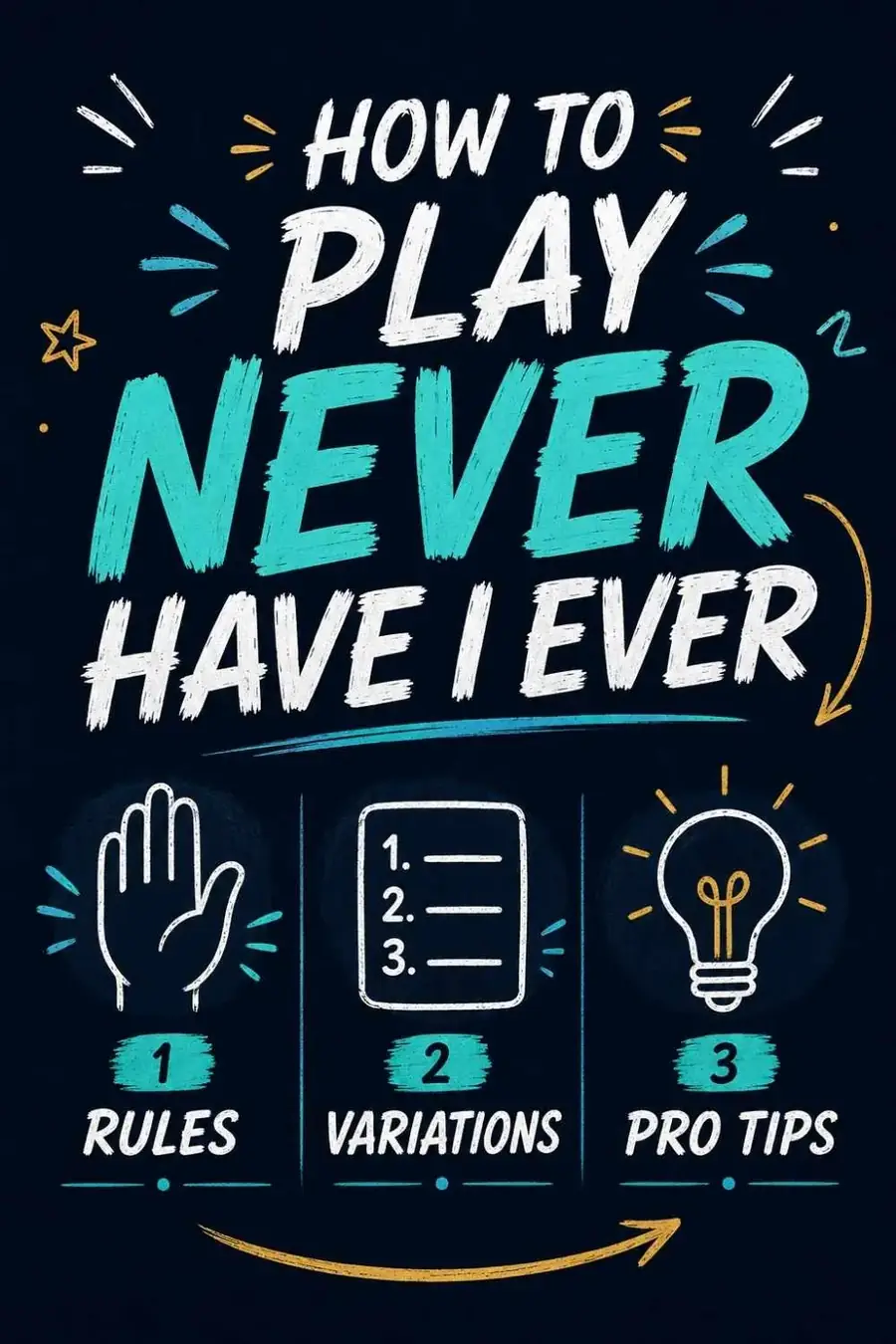
Never Have I Ever is one of those games that most people have played but fewer people have played well. The concept is simple — someone says something they've never done, and everyone who has done it loses a point. But the game becomes something much better than a point-counting exercise when you understand the different versions, the right questions, and how to run it in a way that actually creates connection.
This guide covers everything: the basic rules, every major variation, how to play online and in person, how to manage different group sizes, what questions work best, and how to make sure the game produces what it's supposed to — great conversation, genuine revelations, and one of those nights people remember.
The Basic Rules of Never Have I Ever
The core game is simple enough to explain in sixty seconds:
Players: 2 or more (ideally 3-10 for the best experience)
Setup: No setup required. Everyone sits in a circle, around a table, in a line — anywhere works.
Starting: Whoever goes first says a statement starting with "Never have I ever..." followed by something they've never done.
Example: "Never have I ever been to Europe."
Responding: Every player who HAS done that thing either:
- Puts one finger down (in the finger version)
- Takes a sip (in the drinking version)
- Gives up a token (in the token version)
- Says "I have" (in the verbal version)
Continuing: The next person says their "Never have I ever..." statement, and the process repeats.
Winning: In the finger version, the last player with at least one finger still up wins. In the drinking version, the first player to finish their drink loses (or wins, depending on how you look at it).
That's the complete game. Everything else is a variation on these basics.
The Finger Version (Most Common)
How it works: Each player starts with 10 fingers extended. When you've done the thing being mentioned, one finger goes down. First player to have no fingers remaining loses — or "wins," depending on your group.
Why it works: Visual tracking makes it easy for the whole group to see how everyone is doing. The drama of watching someone's fingers disappear quickly (or slowly) adds stakes to the game.
Best for: In-person groups of 3-10 players. Family settings. Sober or drinking settings.
Tip: Some groups make the first person to hit zero fingers the "winner" (most experienced person) rather than the loser. Reframe based on your group.
The Drinking Version
How it works: Instead of fingers, players have drinks in hand. A player who has done the thing mentioned takes a sip. No elimination — just a natural pace that creates more relaxed gameplay.
Why it works: The absence of elimination removes the competitive tension, which tends to make people more honest and more willing to put a drink down. The game flows more like a conversation.
Best for: Adult groups, parties, pregames.
Important note: This version works with any drink — alcoholic or non-alcoholic. Playing with water, juice, or soft drinks is completely valid and often produces the same energy.
Tip: Set a rule early: no one is required to explain why they drank. This makes people more willing to respond honestly.
The Verbal Version
How it works: No fingers, no drinks. Each person simply says "I have" or "I haven't" — or nods or shakes their head. No scoring. The game runs purely as conversation.
Why it works: Removes competitive pressure entirely. Becomes a conversation format rather than a game. Often the deepest version.
Best for: Close friend groups, couples, small groups who want to talk more than compete.
Tip: The verbal version pairs well with a "follow-up rule": whenever someone says "I have," they give one sentence about it. Just one. The sentence usually becomes a story.
The Token Version
How it works: Give each player 10 coins, candies, chips, or any small objects. One token goes in the middle when you've done something. Player with fewest tokens at the end wins. Alternatively, whoever runs out first can earn a prize or forfeit.
Why it works: Great for kids or settings where visual tracking of tokens is clearer than fingers. Also works with candy as stakes, which motivates younger players significantly.
Best for: Kids' parties, family game nights, large groups where a physical center pile is visible.
Group Versions & Variations
Standing Version
Perfect for parties or kids' games. Everyone stands. One step toward sitting per yes. Last person standing wins.
No tracking, no tokens, no drinks — just bodies and movement. Works for any size group and is especially good for energetic settings.
Prediction Version
Before each question, each player writes down (or silently guesses) who they think will say yes. Reveal simultaneously. Correct guesses earn points.
The game becomes about knowing your friends rather than about your own answers. Excellent for established friend groups.
Two Truths One Lie Hybrid
Alternate between Never Have I Ever rounds and Two Truths and a Lie rounds. Every 5 questions, each player shares two true things they've done and one they haven't. Group guesses the lie.
Adds variety to longer game sessions and combines two of the best icebreaker formats.
Speed Round
Read all questions as fast as possible. No stories, no follow-up. Count at the end. The goal is to process as many questions as possible in 10 minutes.
Great for large groups or as a warmup before a slower, conversation-based version.
Story Mode
After any yes answer, the person who said yes must give one sentence — exactly one sentence — about when or how. No longer.
The one-sentence rule prevents long tangents while still producing the stories that make the game worth playing.
How to Play Never Have I Ever Online
The online version doesn't require any physical setup. You can play:
On a video call (Zoom, Meet, Teams, etc.):
- Everyone shows their hands on camera, fingers go down on screen
- OR everyone types yes/no in the chat simultaneously
- One person is the host and reads questions
- Works for 2-100+ people with different format adjustments
In a group chat (WhatsApp, iMessage, Slack):
- Host posts a question
- Everyone replies yes/no
- Host calls the reactions and moves on
- Asynchronous version works for different time zones
With the online game (neverhaveieveronline.com):
- Full randomized question bank
- Play solo or share the screen for a group
- No download, no account required
How Many Players Work Best?
2 players: Intimate version — best as a couple's game or with a close friend. Use the verbal/conversation version.
3-5 players: Ideal size for the finger version. Everyone can see each other, conversations happen naturally, the game flows well.
6-10 players: Works well with the finger version or token version. Start to see the dynamics where one person's quick finger loss becomes the group entertainment.
11-20 players: Switch to the standing version or show-of-hands version. Individual finger tracking becomes hard to manage.
20+ players: Use breakout groups for the finger version, or run the entire group through the standing/show-of-hands version with a host managing the questions.
What Makes a Good Never Have I Ever Question?
Not all questions are equal. The best questions share a few qualities:
Specific over vague. "Never have I ever traveled" gets nothing. "Never have I ever been on a flight that landed somewhere I didn't plan" gets reactions.
Universal enough that most people have a version. Questions that only one or two people can answer don't work well in groups. The best questions hit something most players have experienced.
Revealing without being invasive. Great questions reveal character, personality, and experience without putting anyone on the spot. They have a low enough stakes that honest answers are easy to give.
Open to follow-up. The best questions have a story behind the yes answer. "Never have I ever done something I said I would never do" invites a story. "Never have I ever eaten food" does not.
25 Questions to Start With
These 25 questions demonstrate what good Never Have I Ever looks like across different categories.
Funny & Universal:
1. Never have I ever waved back at someone who wasn't waving at me.
2. Never have I ever stayed in the car to finish a song before going inside.
3. Never have I ever said "you too" to something that made zero sense.
4. Never have I ever called someone the wrong name and kept going.
5. Never have I ever laughed so hard I made absolutely no sound.
Adventure & Experience:
6. Never have I ever done something impulsive that turned out to be the right call.
7. Never have I ever traveled somewhere that completely changed how I see something.
8. Never have I ever had a night that started as nothing and became a memory.
9. Never have I ever gotten lost and found something better.
10. Never have I ever tried a food I was certain I'd hate and loved it.
Personality & Perspective:
11. Never have I ever changed my mind completely about someone after one conversation.
12. Never have I ever had a gut feeling that turned out to be absolutely right.
13. Never have I ever been surprised by who I turned out to be in a situation.
14. Never have I ever had a moment where I knew, in real time, it was going to become a story.
15. Never have I ever done something out of character and found it wasn't out of character at all.
Deep & Connecting:
16. Never have I ever had a friend who showed up in a moment I still think about.
17. Never have I ever had an ending that was also a beginning I understood later.
18. Never have I ever been changed by something as small as a sentence or a moment.
19. Never have I ever had a hard year that I now consider important.
20. Never have I ever surprised myself with what I was capable of.
Relationship & Love:
21. Never have I ever been in love with someone who didn't feel the same — and kept going.
22. Never have I ever had a relationship — any kind — that taught me something I needed to know.
23. Never have I ever had a friendship strengthen because something hard happened.
24. Never have I ever been changed by how someone loved me.
25. Never have I ever been grateful for a relationship I wouldn't go back to.
Tips for Running a Great Game
Start with easy, funny questions. The tone of the first five questions sets the tone for the entire game. Start universally relatable and let the depth build naturally.
Don't force follow-up. Some questions will produce a finger down and silence. That's okay. The silence is an answer. Don't push.
Watch for the "me too" moments. When multiple people answer yes to the same thing simultaneously — especially something heavy — let that moment land. Acknowledge it. These are the moments that make the game more than a game.
Know when to stay light. Not every game needs to go deep. If the room is in a funny, light mood, stay in the funny, light territory. The deeper questions will land better another time when the energy is ready.
Have more questions than you need. Better to have 50 questions for a 30-question game than to run out. The best games end with the group wanting more, not with you scrambling.
🎮 Play the Full Game Online
🎮 Play Never Have I Ever Free Online — No Download, No Sign-Up Required
▶️ Play Free Now❓ Frequently Asked Questions
How many people do you need?
Minimum 2. The game works better with 3+. The optimal range for the finger version is 3-8 players.
Can you make up your own questions?
Yes — and it's encouraged. Custom questions tailored to your group, occasion, or theme often produce the best moments.
Is Never Have I Ever always a drinking game?
No. The drinking version is one of many. The finger version, verbal version, token version, and standing version all work without any alcohol.
How long does a game last?
Anywhere from 15 minutes (speed round) to several hours (story mode with a long question list). A typical game with 30-50 questions in conversation mode runs about 45-90 minutes.
Can kids play?
Yes — with age-appropriate questions. The game format works for ages 5+. The questions need to be calibrated for the age group.
Is there an age limit?
No minimum age with the right questions. The adult versions with alcohol require legal drinking age — but the game format itself is all-ages.